 blog
7 Steps to Clear a Hoarded House Safely and Compassionately
Last Updated: November 10, 2026
Quick Summary
A hoarded house clearance is a managed, consent-led process combining sorting, safeguarding, deep cleaning and licensed disposal, run by a team trained to move at the occupier's pace rather than the clock. It follows three stages: assessment and risk assessment, sorting belongings with consent, then removal, deep cleaning and handover.
- Sorting is best done with the occupier or their representative present, dividing items into keep, donate, recycle and dispose.
- Valuables and documents should be removed and secured by the family before clearance begins.
- Pricing depends on volume, access, contamination and disposal route, not floor area alone.
- Ask for a written quote that itemises labour, disposal and cleaning separately, and confirm whether hazardous waste is included.
- Clearing a hoarded house secretly while the occupier is out almost always damages trust.
Table of Contents
- Why a Hoarded House Needs a Different Kind of Clearance
- The Hoarded House Clearance Process, Step by Step
- Preparing for a Hoarded Home Clearance: A Room-by-Room Checklist
- What Drives Hoarding House Clearance Cost
- House Clearance Recycling and Disposal: Where Belongings End Up
- Health, Safety and Safeguarding in a Hoarded Home
- A Compassionate, Consent-Led Approach for Relatives and Carers
- Booking a Licensed Hoarded House Clearance
- Frequently Asked Questions
Why a Hoarded House Needs a Different Kind of Clearance
A hoarded house clearance is not a rubbish removal job with more trips to the tip.
The real obstacles are narrower than most people expect. Doorways are often blocked. Floors may not be structurally sound under years of accumulated weight.
Below, we break down the seven steps we use, what drives cost, and how relatives and carers can prepare without causing distress.
The Hoarded House Clearance Process, Step by Step
Every hoarded house clearance we run follows the same three-stage structure, because skipping a stage creates problems that cost more to fix later.

Step 1: Assessment and Risk Assessment
A site visit is the usual starting point, so that access routes, floor loading and hazards can be recorded before any quote is given.
Step 2: Sorting Belongings With Consent
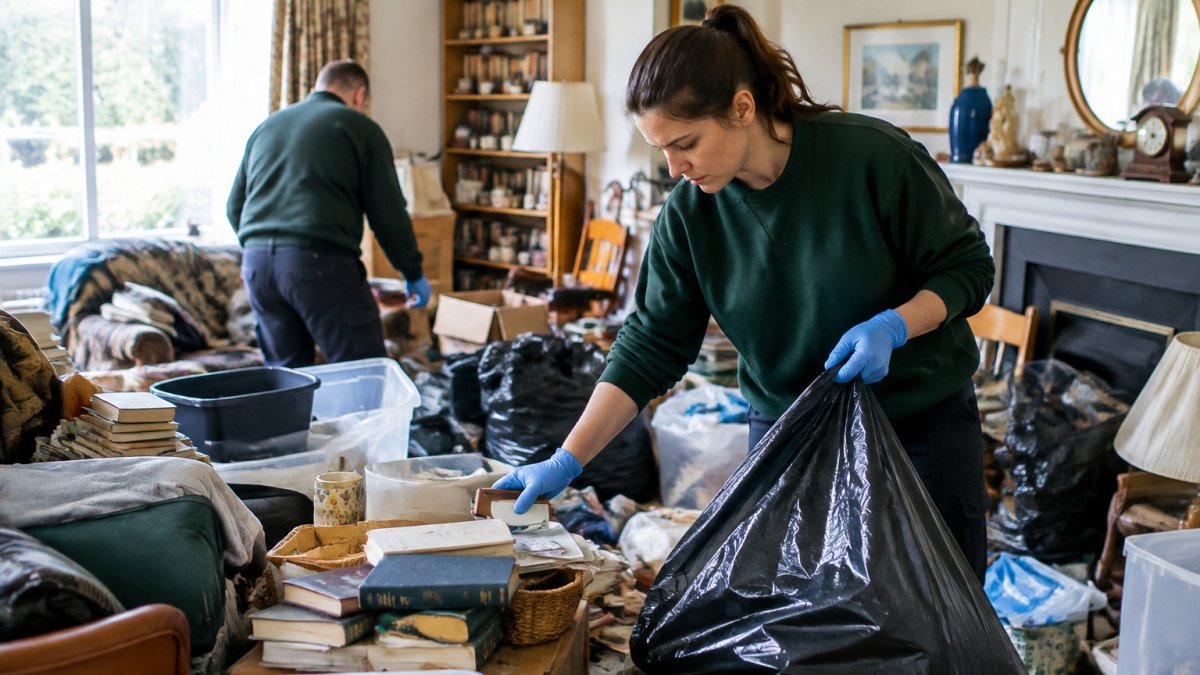
Sorting is best done with the occupier or their representative present, so that items can be divided into keep, donate, recycle and dispose before anything is removed.
Step 3: Removal, Deep Cleaning and Handover
Removal can follow an agreed plan, with waste segregated as it leaves the property, and deep cleaning is usually carried out after clearance rather than before.
Preparing for a Hoarded Home Clearance: A Room-by-Room Checklist
Preparation can reduce both cost and distress. Work through the checklist below in order, as access and consent come first.
Before you touch anything: access, consent and authority
- Confirm who has authority to instruct the clearance. If the occupier has capacity, their consent should be explicit and recorded in writing. If they lack capacity, authority must come from the correct legal route, such as a deputyship or a Court of Protection order. For a deceased estate, probate may be required.
- Agree the access route. Identify the door the team will use, whether keys are held, parking arrangements, and any communal access needing permission from a landlord or managing agent.
- Check the utilities. Confirm where the stopcock, fuse board and gas meter are, and whether any are blocked.
The room-by-room checklist
- Hallway and stairs: clear a walkable path at least one person wide; confirm the handrail is secure
- Living room: identify sentimental items and photographs first; set them aside in a single labelled box
- Kitchen: remove all food waste and perishables; check for pests under the sink and behind appliances
- Bathroom: flag any mould or leaks; remove medicines for separate disposal
If the occupier is moving to a care setting, agree in advance which items travel with them.
The five categories to settle before removal starts
Sorting is faster and calmer if you decide each category's destination in advance, rather than item by item on the day:
- Retain: the keep pile, confirmed by the occupier or their representative before anything leaves. Label the boxes and photograph them.
- Valuables and documents: cash, jewellery, deeds, insurance papers, passports and financial records. These should be removed and secured by the family before clearance begins, not left for the team to find.
- Medication: collect all medicines, including out-of-date ones, for separate disposal through a pharmacy rather than the general waste stream.
- Donate or resell: usable furniture, clothing and household goods. Agree which charity or resale route will take them, and check whether collection is available.
Documents, privacy and the property's condition
Personal records, bank statements, medical letters, photographs, should be handled by the family or representative wherever possible, and any not retained should be shredded or securely disposed of. Before work begins, photograph each room and note any pre-existing damage for a clear record at handover.
Watch out: removing items before the retain pile is confirmed is the most common cause of family disputes and of items that cannot be recovered.
When to pause and refer
Preparation is also the point to notice when a clearance is not the right first step. If the occupier appears at risk, the right response is referral, not removal, adult social services at the local authority can assess needs, and charities such as Hoarding UK offer support and advice for families. A clearance arranged around an unresolved safeguarding concern tends to fail and to damage trust.
What Drives Hoarding House Clearance Cost
Pricing depends on volume, access, contamination and disposal route, not on floor area alone. A hoarded house clearance cost is built from four main components:
| Cost factor | What it covers | What pushes it up |
|---|---|---|
| Labour | Number of staff and hours on site | Blocked access, upper floors, dense clutter |
| Waste disposal | Licensed tipping and recycling fees | Non-recyclable material, contaminated items |
| Hazardous waste | Separate compliant disposal | Asbestos, chemicals, sharps, biohazards |
| Deep cleaning | Post-clearance sanitising | Pest activity, mould, animal waste |
Pricing depends on volume, access, contamination and disposal route, so no two properties are priced the same. Ask for a written quote that itemises labour, disposal and cleaning separately, and confirm whether hazardous waste is included. For current prices or a quote, contact Junkmove Ltd directly.
The three pricing models you will be quoted
Clearance pricing is often structured in one of several ways, and the model matters as much as the number:
- Hourly rate plus disposal: you pay for staff time and then for each load tipped or recycled. Transparent on labour but open-ended on total cost. Ask for the hourly rate, the minimum call-out, and the per-load or per-tonne disposal charge before you agree.
- Fixed price after survey: a single figure agreed after the assessor has seen the property. Best for budgeting, but only as good as the survey, insist the quote states what is excluded (hazardous waste, deep cleaning, structural repairs).
- Room-by-room or volume-based: priced per room or per cubic metre. Useful for partial clearances where the occupier keeps some rooms intact, but it can penalise you if clutter is unusually dense in one area.
A common pattern is a fixed price for removal plus separate lines for deep cleaning and hazardous waste. Insist on that separation: a single all-in figure hides which costs are avoidable.
What actually moves the number
Beyond volume, four things swing a hoarded-house quote more than most people expect:
- Access and distance to the van. A ground-floor property with a clear front path is the cheapest configuration. Upper-floor flats, narrow stairwells, shared communal halls and parking restrictions add labour hours because every load is carried further and slower.
- Contamination and biohazards. Animal waste, mould, sharps and pest activity require protective equipment, separate bagging and compliant disposal routes, usually charged as a distinct line.
- Hazardous materials. Asbestos-containing materials, chemicals, paint, fuel and gas cylinders cannot go in a standard skip. They need a licensed route and a separate charge, and in older properties asbestos is the single most common surprise.
- Cleaning depth. A broom-swept empty room is not the same as sanitising after pest or animal contamination. Agree the cleaning standard in writing before work starts.
A worked example of how a quote is built
Consider a two-bedroom terraced house with blocked access, one contaminated bathroom and a garage of paint tins. A written quote for such a property would ideally separate labour, general disposal, hazardous waste and deep cleaning, so you can see what changes the price.
Watch out: a quote that excludes hazardous waste and deep cleaning can look cheapest on the day and end up the most expensive once those lines are added back.
Questions that expose a vague quote
Before you compare two quotes, ask each provider: Is the price fixed or hourly, and what is the minimum charge? Is hazardous waste included, and if not, how is it priced? Is deep cleaning included to a stated standard? What happens if the volume is greater than the survey suggested, is there a cap? Are disposal and transfer notes provided?
House Clearance Recycling and Disposal: Where Belongings End Up
Belongings do not all go to landfill, and you are entitled to ask where they go. Under the government's waste duty of care guidance, anyone producing household waste has a legal duty to ensure it is transferred only to an authorised carrier, and you can ask to see the waste carrier licence and a transfer note.
Furniture, clothing and household goods in usable condition can often be donated. Metals, cardboard and electrical items can go to recycling streams. Ask for confirmation in writing before work begins.
Health, Safety and Safeguarding in a Hoarded Home
Safety governs every decision on site. Common hazards include structural weakness, blocked fire exits, vermin, mould, sharps and unstable stacks. Clearance teams should work to a written risk assessment, wear protective equipment, and avoid entering a property alone where hazards are present.
Safeguarding sits alongside safety. Hoarding is recognised as a complex mental health condition, and Mind's guidance on hoarding disorder notes that it often coexists with anxiety, depression or trauma. Adult social services at the local authority can assess needs, and charities such as Hoarding UK offer support and advice for families.
A Compassionate, Consent-Led Approach for Relatives and Carers
The most common mistake families make is clearing a hoarded house secretly, while the occupier is out. It feels faster.
Where the occupier has capacity, their consent should be explicit and recorded.
In practice, this means slower starts and better outcomes, with time allowed for the occupier to handle items, change their mind, and say goodbye to possessions.
Booking a Licensed Hoarded House Clearance
Check that a provider holds a valid waste carrier licence, and ask for a written quote that separates labour from disposal.
Junkmove Ltd provides licensed house clearance across Kent, Rochester and the Medway area, with tailored clearance plans, environmentally responsible disposal and same-day service available.
Clearing a hoarded home is emotional work, and the practical decisions rarely feel simple.
Frequently Asked Questions
How much does it cost to clear a hoarded house?
There is no fixed price, because hoarding house clearance cost depends on the volume of clutter, how many floors and rooms are involved, access and parking, and how much hazardous or contaminated waste needs separating. A single packed room costs far less than a whole property. Ask for a free quote after an assessment so the figure reflects your actual property, and confirm what is included: labour, waste disposal, cleaning and any permit charges.
How long does a hoarded house clearance take?
A single room can often be cleared in a day, while a full three-bedroom hoarded house typically takes several days once sorting, removal and deep cleaning are counted. Severe cases with restricted access or heavy contamination take longer. The hoarded house clearance process usually starts with an assessment so the team can give you a realistic schedule, and urgent jobs such as a property sale can be discussed with the provider directly.
Do I need to sort belongings before a hoarded home clearance?
You do not have to, but preparing for a hoarded home clearance makes the job faster and cheaper. Set aside a clear area for items to keep, gather documents, photos, jewellery and medication first, and label anything that must not be removed. A consent-led clearance team will then sort the rest with you or your relative, setting aside donations and recyclables rather than treating everything as rubbish.
What happens to items removed during a hoarded house clearance?
A responsible provider can explain how items are separated as part of house clearance recycling and disposal. Reusable furniture, clothing and household goods can go to donation or reuse, and recyclable materials can be processed. Hazardous items such as chemicals, paint and asbestos-containing materials need separate handling. Ask for a Waste Carriers Licence and a waste transfer note so you can see where everything went.