 How-to
How to Verify a Waste Carrier Licence Before You Hire
Last Updated: October 26, 2026
Quick Summary
To verify a waste carrier licence, search the correct regulator's public register for the carrier's operating area by registration number or business name, then confirm the status is current, the business identity matches, and the scope covers the work booked. Save the result with the date and register you used as evidence of due diligence.
- Registration is devolved: England uses the Environment Agency, Wales Natural Resources Wales, Scotland SEPA, and Northern Ireland the NIEA.
- Search by registration number first, as it is faster and more reliable than searching by business name.
- An expired registration means the carrier cannot legally operate, so confirm current status on the day you hire.
- Ask for a waste transfer note showing the carrier's name and registration number, waste description, date, place, and destination.
- Never pay cash without a transfer note, and refuse quotes that are suspiciously low.
Table of Contents
- Why Verifying a Waste Carrier Licence Protects You
- How to Check Waste Carrier Registration on the Public Register
- Searching by Waste Carrier Registration Number or Business Name
- Reading the Results: Registration Status, Scope and Expiry
- When Details Do Not Match or the Carrier Cannot Be Found
- Getting the Waste Transfer Note for Household Waste
- How to Avoid Illegal Waste Dumping and Fly-Tipping
- Booking a Licensed Waste Clearance You Can Trust
- Frequently Asked Questions
Why Verifying a Waste Carrier Licence Protects You
Every load of rubbish you hand over leaves a paper trail that leads straight back to you, which is why a waste carrier licence check matters before you book. That is the uncomfortable truth about how to verify waste carrier license checks, and it is why this guide from Junkmove Ltd starts with the risk, not the register.
Waste carrier registration is the legal permission a business needs to transport, buy, sell, or dispose of controlled waste. Anyone who moves your rubbish for money must hold one, or operate under an exemption. No exceptions.
Here is what most guides get wrong: they treat the check as a box-ticking exercise. It is not. Under the duty of care rules enforced by the Environment Agency's waste duty of care guidance, you must take reasonable steps to confirm your waste goes to an authorised carrier. If it does not, you can be the one facing a fine.
That single fact changes the whole job. You are not just hiring a van. You are choosing who carries your legal responsibility for the next stage of that waste's life.
A common mistake is assuming a smart website or a branded van proves legitimacy. It proves nothing. Only the public register does.
How to Check Waste Carrier Registration on the Public Register
The check itself takes about two minutes, but only if you start at the right register. Registration is devolved, so the regulator and the public register depend on where the carrier operates.
| Where the carrier is based or operates | Regulator | Public register to search |
|---|---|---|
| England | Environment Agency | Public register of waste carriers, brokers and dealers |
| Wales | Natural Resources Wales | Waste carriers, brokers and dealers register |
| Scotland | Scottish Environment Protection Agency (SEPA) | Waste carrier register |
| Northern Ireland | Northern Ireland Environment Agency (NIEA) | Waste carrier, broker and dealer register |
If a carrier collects across borders, check every register that applies. A registration in one nation does not automatically authorise work in another.
Follow these steps:
- Identify the correct regulator for the carrier's operating area using the table above.
- Open that regulator's public register of waste carriers, brokers and dealers.
- Choose your search type: by registration number or by business name.
- Enter the details exactly as the company gave them to you, including any prefix or spacing in the registration number.
- Open the matching record and read the full entry, not just the top-line status.
- Save the result with the date, the search terms used, and the register you searched.
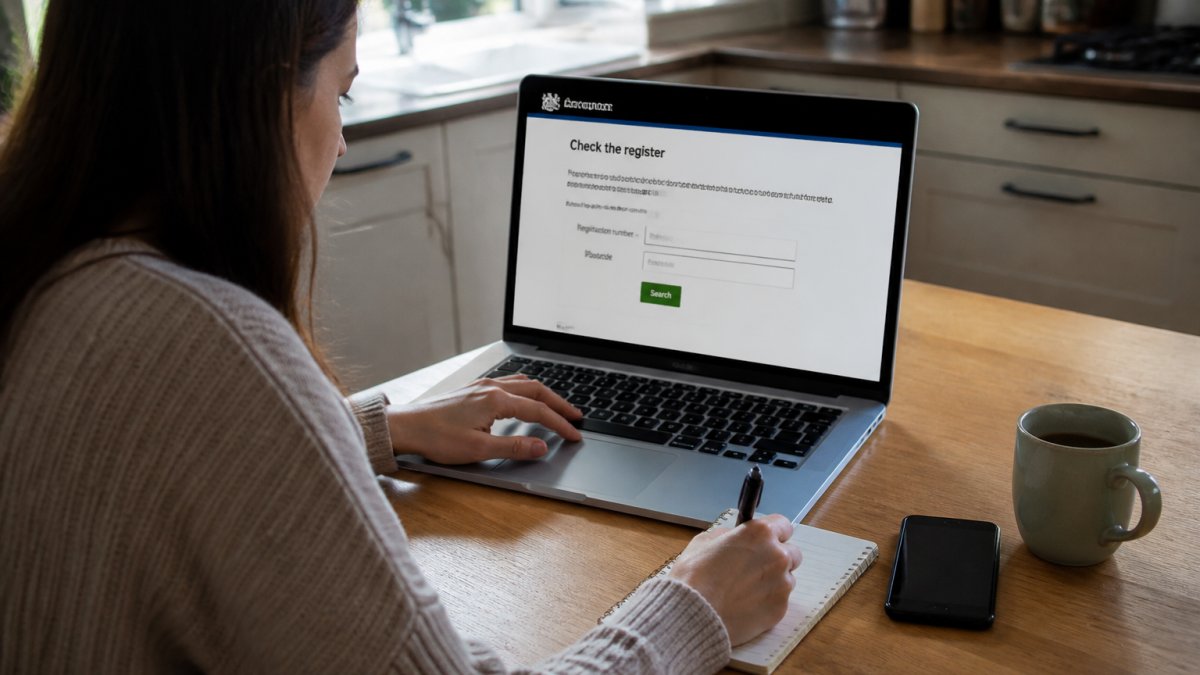
That saved record matters. It is your proof that you carried out due diligence at the point of hire. Keep it with your paperwork, alongside the waste transfer note.
Searching by Waste Carrier Registration Number or Business Name
Two search routes exist, and each suits a different situation. Use the registration number when you have it. Use the business name when you do not.
Search by registration number is the fastest and most reliable. Ask the company for their number before you book. A legitimate operator will give it without hesitation.
Search by business name throws up more noise. You may see several similar entries, trading names, or group companies. Match carefully on:
- Full legal company name
- Trading name
- Registered address
- Registration status
Watch out: a matching name is not a matching business. Check the address and number against what the company told you. If a trader dodges your request for a registration number, treat that as a red flag.
Reading the Results: Registration Status, Scope and Expiry
A register entry is more than a yes or no. It tells you whether the registration is current, what the carrier is allowed to do, and when it runs out.
Check these fields:
| What to Check | Why It Matters |
|---|---|
| Registration status | Confirms the licence is valid, not expired or revoked |
| Registration type | Shows if they are a carrier, broker, dealer, or a mix |
| Expiry date | A lapsed registration means they cannot legally operate |
| Registered address | Helps confirm you have the right business |
| Upper tier or lower tier | Indicates the scope of what they can handle |
An expired registration is the trap most people miss. The company may have been legitimate last year. That does not help you now. Always confirm the status is current on the day you hire.
Scope matters too. A registration that covers collection may not cover brokerage. If in doubt, ask the company to confirm what their licence allows.
When Details Do Not Match or the Carrier Cannot Be Found
No result is still a result, but not every failed search means the carrier is unregistered. Work through the possibilities before you walk away, or before you book.
Step 1: Re-run the search with variations.
- Try the full legal company name as well as the trading name.
- Remove or add "Ltd", "Limited", "& Sons", and punctuation.
- Check spacing and prefixes in the registration number (for example, whether it begins with a letter code or is written without spaces).
- Search the register for the registered address rather than the name.
Step 2: Ask the carrier for their legal entity and number in writing. A genuine operator will supply the registered company name, the registration number, and the regulator they are registered with. A dodgy one will make excuses or go quiet.
Step 3: Match the details field by field.
| What you were told | What the register shows | Action |
|---|---|---|
| Same name, same number, current status | Match | Proceed, and save the record |
| Similar name, different number | Possible trading name or group company | Ask for the legal entity that holds the registration |
| Same name, expired or revoked status | Lapsed registration | Do not book until a current registration is produced |
| Same name, different address | Possible impersonation or outdated record | Pause and verify directly with the regulator |
| No result on any register | Not registered, or registered elsewhere | Do not hand over waste |
Step 4: Pause the collection if anything does not line up. Mismatched addresses, names, or vehicle details are exactly the kind of gap that hides an unregistered carrier. Do not let waste leave your property until the mismatch is resolved.
Step 5: Report concerns. If you believe a carrier is operating without registration, or is misrepresenting their status, report it to the regulator for the nation where the work is taking place, the Environment Agency, Natural Resources Wales, SEPA, or the NIEA. Keep your search record and any correspondence; it supports the report and protects you if the waste is later fly-tipped.
Getting the Waste Transfer Note for Household Waste
A waste transfer note is the document that records a transfer of waste from one party to another. It is your written proof of what was collected, by whom, and when.
For household waste, the rules are slightly softer than for business waste, but the principle holds. Ask for a transfer note or a receipt that shows:
- The carrier's name and registration number
- A description of the waste
- The date and place of transfer
- Where the waste is going
Keep it. If your rubbish later turns up fly-tipped, that note is your defence. Without it, you have nothing to show you acted responsibly.
How to Avoid Illegal Waste Dumping and Fly-Tipping
Illegal dumping and fly-tipping usually start with a cheap quote and a cash-in-hand van. The waste gets collected, then tipped in a layby or a farmer's field. Your name is still on it.
To avoid becoming part of that chain:
- Never pay cash without a transfer note
- Refuse quotes that are suspiciously low
- Confirm the carrier's registration before they load anything
- Ask where the waste is being taken
- Keep every document
Many businesses find that a short, honest conversation about disposal routes separates the professionals from the cowboys. If they cannot tell you where your waste goes, they are not the right choice.
Booking a Licensed Waste Clearance You Can Trust
The simplest way to skip the risk is to hire a carrier who is already registered and happy to prove it. That is exactly what we do at Junkmove Ltd.
We hold a Waste Carriers Licence, and we will show it to you before we start. Our team handles house clearances, rubbish removal, and full property clearances across the region, with recycling, composting, and waste-to-energy built into how we work.
You get a tailored plan, same-day service where needed, and a proper paper trail for every load.
Frequently Asked Questions
What do I need a waste carrier licence for?
Anyone who transports, buys, sells or disposes of waste as part of a business needs a waste carrier licence. That includes rubbish clearance firms, builders removing site waste and waste brokers. As a householder you do not need one to take your own rubbish to a recycling centre, but any company you pay to remove waste must hold one. Hiring an unregistered carrier can leave you exposed to enforcement action and a fine, because the duty of care sits with whoever produces the waste.
Can I check a waste carrier's registration for free?
Yes. The public register is free to search and is run by the Environment Agency. You can look up a carrier by business name or by waste carrier registration number, and download results if you need a record. There is no charge and no account needed. Ask the company for its registration number before you book, then confirm it matches the name, trading name and status shown on the register. If the details do not line up, walk away.
How can I tell whether a waste carrier's registration is still valid?
The register entry shows whether the registration is current or has expired, along with the expiry date. Check that the status is active and that the date has not passed. Also confirm the registration covers the type of work you are hiring for, since upper and lower tier registrations differ. Make a note of the date you checked. A carrier whose registration lapses partway through your job is no longer authorised, so it is worth re-checking before a large clearance.
What records should I keep after a waste collection?
Keep the waste transfer note for household waste, which should name the carrier, its registration number, the waste type and where it went. Store it with your invoice and a screenshot of the register entry you checked. For businesses, keep these records for at least two years, and for householders it is still wise to hold them until any sale or dispute is settled. If fly-tipped waste is later traced back to your address, that paperwork is your proof that you used a registered carrier.
Ready to clear your space without the legal worry? Get started with Junkmove Ltd and book a licensed, fully documented waste clearance you can trust.